

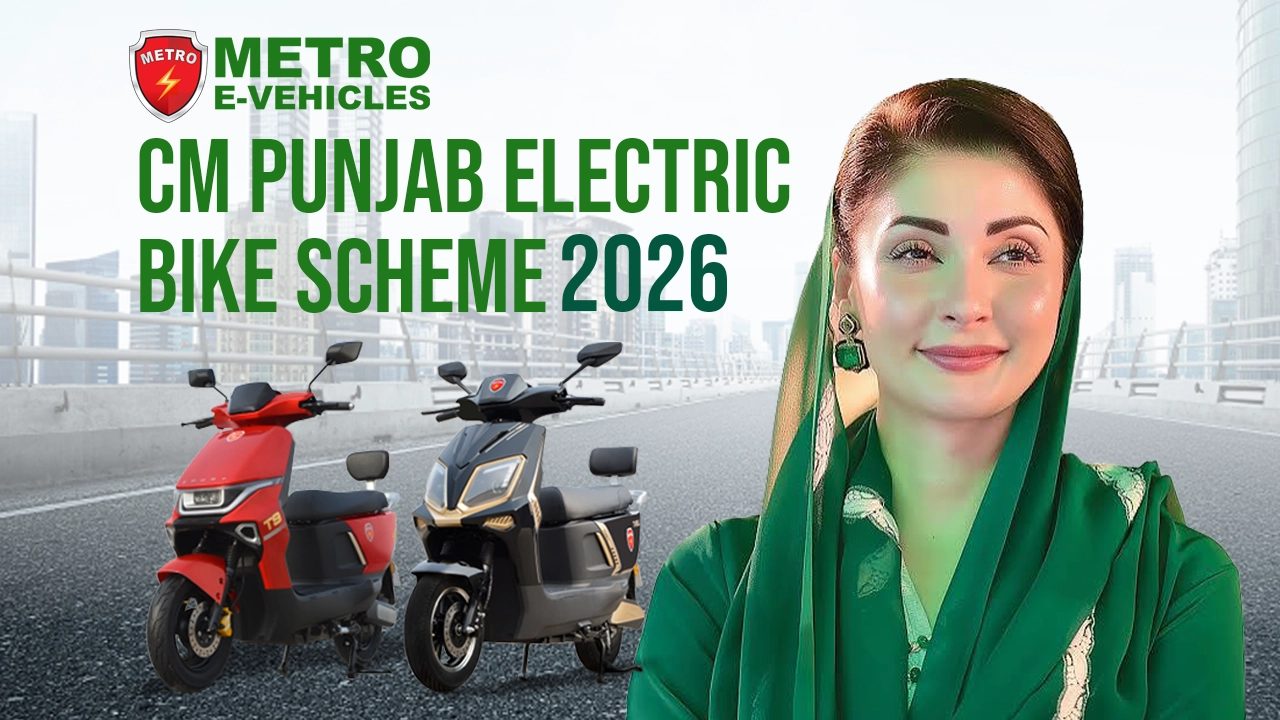
Getting to campus, work, or the local market shouldn’t eat up half your monthly budget. That’s the exact problem the Government of Punjab is trying to solve with its much-talked-about Electric Bike Scheme, officially rebranded this year as the CM Punjab’s Green Initiative E-Bikes Scheme. With fuel prices climbing and public transport becoming increasingly unreliable in many districts, this program aims to put an affordable, eco-friendly ride within reach of hundreds of thousands of students — and, in later phases, government employees and teachers too.
If you’ve been hearing about this scheme on social media or from classmates and want the full picture — who qualifies, how to apply, what it costs, and what to watch out for — this guide breaks it all down.
What Exactly Is the Scheme?
The CM Punjab Electric Bike Scheme is a subsidized financing program, not a free giveaway. Chief Minister Maryam Nawaz relaunched applications for the 2026 cycle, opening the portal to the public on September 5, 2026. Under this phase, the provincial government intends to distribute around 100,000 electric bikes to students studying across more than 33,000 public and private educational institutions in Punjab, spanning schools, colleges, and universities.
The program is delivered in partnership with the Bank of Punjab (BOP), which handles the actual loan disbursement, applicant verification, and monthly installment collection. The government’s role is to subsidize the markup — in other words, it pays the interest so that the applicant doesn’t have to. That’s what makes this scheme attractive: you’re not getting a bike handed to you, but you are getting an interest-free loan with a manageable monthly payment plan.
Importantly, the scheme isn’t limited strictly to electric bikes. A parallel track for petrol bikes exists as well, so applicants can choose the option that suits them best — though you can only apply for one or the other, not both.
Why the Government Launched This
Punjab’s public transport infrastructure hasn’t kept pace with the growing number of students commuting to college and university campuses every day. Rising fares on buses and rickshaws, combined with unpredictable fuel costs, have made the daily commute a genuine financial strain for many families. Electric bikes offer a way around that: lower running costs, no fuel expense, and a smaller environmental footprint compared to petrol-powered alternatives.
The scheme also fits into a broader push by the Punjab government toward green mobility, positioning electric two-wheelers as a practical, everyday solution rather than a niche or luxury product.
How the Scheme Has Evolved: Phase 1 vs Phase 2
When the program first rolled out, Phase 1 was limited to degree college and university students in just five cities: Faisalabad, Multan, Bahawalpur, Rawalpindi, and Lahore. Even within that narrower geographic scope, more than 800,000 students across the province had a shot at applying, giving a sense of just how much demand exists for affordable transport options.
Phase 2 has widened the net considerably. Eligibility has now been extended to students across all districts of Punjab, not just the original five cities. If you sat out the first round because your district wasn’t included, that restriction no longer applies — this is one of the biggest changes in the current cycle.
Beyond geography, the scheme has also expanded into new applicant categories:
- Junior government employees (BPS grades 1–16) can now apply for interest-free electric bikes through a parallel provincial track, mirroring a similar federal initiative approved for junior federal staff.
- School teachers have their own dedicated program launched under the Punjab Teachers Foundation, with its own separate portal, financing structure, and selection process — starting with 5,000 teachers in the first round and more planned for later phases.
Each of these tracks has its own eligibility rules and application workflow, so it’s worth double-checking which category applies to you before you start filling out forms.
Who Is Eligible to Apply?
Eligibility criteria differ slightly depending on which track you fall under, but for the main student scheme, the general requirements are:
- You must be currently enrolled as a “regular” student in a degree program at a university or graduate college in Punjab — public or private — that is duly recognized by the Higher Education Commission (HEC).
- You must be at least 18 years old.
- You must hold a valid motorcycle learner’s permit or driving license, issued by a licensing authority. This applies equally to male and female applicants — there’s no exemption from this requirement for anyone.
- You can only apply for either the electric bike or the petrol bike option, not both.
- If multiple siblings from the same household are selected through the balloting process, only one sibling will ultimately be awarded a bike.
Your “bonafide student” status will be verified directly by your educational institution, so make sure your enrollment records are current before applying.
For the government employee track, applicants generally need a service certificate from their department, a No Objection Certificate authorizing salary deductions for the installments, proof of Punjab domicile, a valid motorcycle license or learner’s permit, and a guarantor.
For teachers, eligibility is fairly broad within the school education system — PST, Elementary, EST, and General cadre teachers, whether permanent or on contract, can apply through the separate Punjab Teachers Foundation portal.
How to Apply: Step-by-Step
The application process is entirely online — there are no manual forms or physical submission offices involved. Here’s the general workflow for the student track:
- Visit the official portal. Go to
bikes.punjab.gov.pk, the official website for the CM Punjab E-Bike Scheme. - Create an account. Click the “Apply Now” button to begin setting up your profile. You’ll typically need your CNIC number and mobile number to register.
- Fill in your personal and academic details. This includes your full name, gender, contact information, and details of your educational institution and enrollment status.
- Choose your bike. Students can browse a catalogue of approved electric and petrol bike models directly on the portal. You can only select from the bikes listed in this catalogue — models outside of it are not eligible under the scheme. A short window to change your selection has sometimes been made available in past rounds, so it’s worth finalizing your choice thoughtfully rather than rushing it.
- Upload required documents. Have scanned copies ready of your CNIC, your learner’s permit or driving license, proof of enrollment, and any other documents the portal requests.
- Submit your application.
- Wait for the balloting results. If applications exceed the allocated quota for your district or category — which is common given the scale of demand — a transparent e-balloting process is used to select successful applicants.
- Financial scrutiny. If you’re selected in the ballot, the Bank of Punjab will carry out a financial review of your guarantor or co-borrower. Only applicants who pass this post-balloting scrutiny are finally confirmed to receive a bike. BOP may request additional documentation at this stage.
Given the scrutiny stage, it’s a good idea to have a guarantor lined up in advance and to make sure their financial documentation is in order before you’re selected — it can save time if your application is chosen.
What Will It Cost You?
The whole point of the scheme is to make bike ownership affordable through manageable monthly payments rather than a lump-sum purchase. Reported figures for the current phase put electric bike installments in the range of roughly Rs. 2,000 to 3,000 per month, with petrol bike installments set slightly differently. Because the government covers the interest markup, what you pay each month goes toward the principal cost of the bike itself rather than extra financing charges.
Exact installment amounts, subsidy figures, and deadlines can shift between phases, so always check the current numbers directly on the official portal rather than relying on older figures once you’re ready to apply.
A Word of Caution
Because this scheme has generated so much public interest, it has also attracted a fair amount of noise online — unofficial “guide” websites, look-alike portals, and third-party pages claiming to offer shortcuts or guaranteed selection. The only official application portal for the student scheme is bikes.punjab.gov.pk. The teacher-specific program runs through ptf.punjab.gov.pk. Avoid submitting your CNIC, financial details, or any documents through unofficial links shared on social media, and be skeptical of any source promising to “guarantee” you a spot in the ballot — the selection process is based on transparent e-balloting, not paid shortcuts.
Final Thoughts
The CM Punjab Electric Bike Scheme 2026 represents a genuinely ambitious attempt to tackle the everyday cost of commuting for students, and increasingly for teachers and junior government staff as well. With Phase 2 opening eligibility to every district in the province, far more people now have a realistic shot at applying than in the scheme’s first round.
If you think you qualify, the most useful thing you can do right now is gather your documents — CNIC, learner’s permit or license, and proof of enrollment — and head straight to the official portal to register before quotas fill up in your district. Given the scale of demand seen in earlier phases, applying early and making sure your paperwork is complete gives you the best chance of a smooth process if you’re selected in the ballot.