

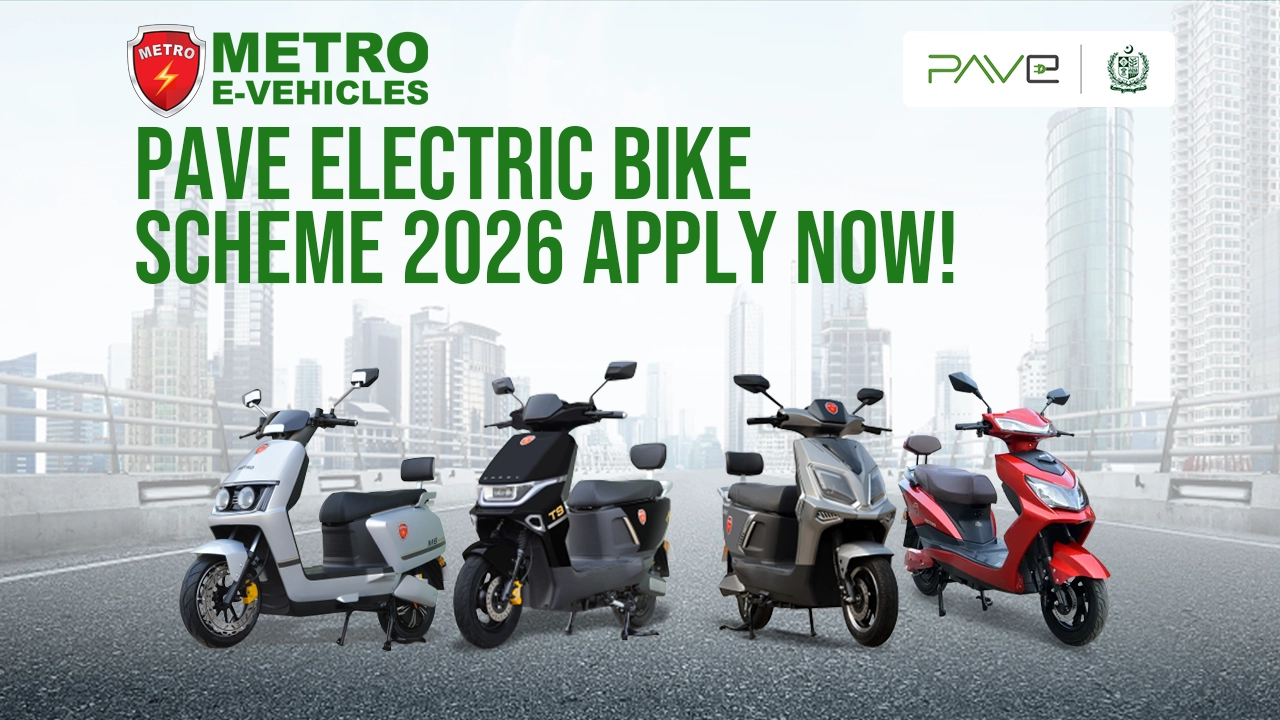
Pakistan’s shift toward electric mobility has picked up real momentum in 2026, and at the center of it sits PAVE — the Pakistan Accelerated Vehicle Electrification Program. If you’ve been searching for an affordable way to switch from a petrol motorcycle to an electric one, the PAVE electric bike scheme 2026 is probably the single most important program to understand right now. In this guide, we’ll break down what PAVE actually is, how the subsidy works, who can apply, and what’s changed in the program’s second phase.
What Is the PAVE Scheme?
PAVE stands for the Pakistan Accelerated Vehicle Electrification Program, a federal initiative run under the New Energy Vehicle (NEV) Policy 2025–30. The policy itself was approved by the federal cabinet in August 2025, and PAVE is the mechanism through which the government is turning that policy into something ordinary citizens can actually benefit from — a direct cash subsidy on the purchase of an electric two- or three-wheeler.
Unlike vague policy announcements that never reach the average buyer, PAVE is built around a simple idea: reduce the upfront cost of an electric motorcycle, rickshaw, or loader enough that switching away from petrol actually makes financial sense for students, commuters, and small business owners. Applications, verification, and tracking are all handled through the official portal at pave.gov.pk, which keeps the process digital and, at least on paper, free of the kind of manual interference that has plagued older subsidy schemes in Pakistan.
The bigger goal behind PAVE isn’t just individual savings, though. Pakistan spends a significant chunk of its import bill on fuel, and two- and three-wheelers make up a huge share of the vehicles on the country’s roads. Electrifying that segment is one of the more realistic near-term ways to cut fuel imports and reduce urban emissions, which is why PAVE has become a flagship piece of the government’s broader EV strategy.
How Much Subsidy Does PAVE Offer?
The subsidy structure is what makes PAVE worth paying attention to. Under the current phase, approved electric motorcycles qualify for a subsidy of around Rs 80,000 per unit. For electric rickshaws and loaders — vehicles that matter enormously to small transport operators and last-mile delivery businesses — the subsidy climbs much higher, reaching up to Rs 400,000 depending on the category and approved vehicle model.
This tiered structure matters because it targets two very different groups at once: individual commuters and students who need an affordable personal bike, and small entrepreneurs who rely on rickshaws and loaders for their livelihood. By subsidizing both ends, PAVE is trying to electrify not just personal transport but a meaningful slice of Pakistan’s informal commercial transport sector too.
It’s worth noting that the subsidy only applies to vehicles and models that have been formally approved under the scheme. Buying just any electric bike off the market won’t automatically qualify you — the vehicle has to come from an Original Equipment Manufacturer (OEM) that’s been registered and approved through the PAVE program.
PAVE Phase 2: What Changed in 2026
The original version of PAVE relied on computerized balloting — essentially a lottery system where applicants were randomly selected from a pool. That worked reasonably well for fairness, but it also meant a lot of eligible applicants simply didn’t get picked, no matter how early or complete their application was.
That changed in May 2026. The Economic Coordination Committee approved Phase 2 of the program, and with it came a major shift in how applicants are processed: PAVE moved from computerized balloting to a first-come, first-served model. In practical terms, this means your application timestamp is now what determines your place in the queue, not a random draw.
This is a significant change for anyone planning to apply. Under the ballot system, applying early didn’t necessarily help — everyone had an equal shot regardless of timing. Under the first-come, first-served model, speed genuinely matters. Since the total vehicle quota under Phase 2 is fixed, the application window doesn’t close on a fixed calendar date — it closes the moment the available allocations are used up. That means there’s no guaranteed deadline to plan around, and applicants who wait too long risk missing out even if the scheme is technically still “open.”
If you’re serious about getting a subsidized electric bike through PAVE, the practical takeaway is simple: get your documents ready now, rather than waiting for a public “last date to apply” announcement that may never come.
Who Can Apply for PAVE?
Eligibility criteria are set by the federal program and generally require applicants to:
- Be a Pakistani citizen with a valid CNIC
- Meet the age requirements specified for the relevant vehicle category
- Apply through the official pave.gov.pk portal using accurate personal and financial information
- Purchase the electric vehicle from an approved OEM once selected or approved
Certain quota categories exist for specific applicant groups, and those applying under a quota typically need to submit additional supporting documents to prove eligibility. Because requirements can be updated as the program evolves, it’s worth double-checking the current criteria on the official portal before you begin the application process, rather than relying solely on secondhand summaries — including this one.
How to Apply: A Step-by-Step Overview
While the exact interface may be tweaked over time, the general application flow for PAVE looks like this:
- Visit the official portal at pave.gov.pk and create an account using your CNIC.
- Fill out the application form with accurate personal, contact, and financial details. Since PAVE has shifted to first-come, first-served processing, incomplete or incorrect information can cost you valuable time if you need to correct and resubmit.
- Select your preferred vehicle category — electric motorcycle, rickshaw, or loader — based on what you’re eligible for and what suits your needs.
- Upload required documents, which typically include your CNIC copy and any category-specific proof (student ID, employment proof, or quota-related documents).
- Submit and track your application status through the portal’s dashboard, which shows real-time updates on where your application stands in the queue.
- Complete verification and purchase once approved, buying the electric vehicle from an authorized OEM and receiving the subsidy after the final verification step.
Throughout this process, patience and accuracy go hand in hand. Since there’s no fixed deadline and slots are filled on a rolling basis, submitting a clean, complete application as early as possible is your best strategy.
PAVE vs. Provincial Schemes: Don’t Get Confused
One source of confusion worth clearing up: PAVE is a federal program, separate from provincial initiatives like the CM Punjab Electric Bike Scheme, which is run through the Bank of Punjab and offers interest-free installment plans specifically to Punjab’s students, teachers, and government employees. The two programs aren’t mutually exclusive in concept, but they operate through different portals, different funding mechanisms, and different eligibility rules. If you’re a Punjab resident, it’s worth checking both PAVE and the relevant provincial scheme to see which one — or possibly both, depending on the rules at the time — fits your situation better.
Why PAVE Matters for Pakistan’s EV Future
It’s easy to look at PAVE as just another subsidy program, but the timing and scale behind it suggest something bigger. Pakistan’s roads are dominated by petrol-powered two-wheelers, and that segment alone accounts for a huge share of both fuel consumption and urban air pollution. A program that meaningfully lowers the cost of switching to electric — backed by real cabinet-level policy and a functioning digital application system — has the potential to shift adoption curves faster than awareness campaigns or import policies alone ever could.
For everyday commuters, the appeal is straightforward: lower running costs, no fuel price anxiety every time petrol rates change, and a genuine government subsidy that reduces the sticker shock of buying electric. For small transport and delivery operators, the higher subsidy on rickshaws and loaders could meaningfully change the economics of switching their entire fleet.
Final Thoughts
The PAVE electric bike scheme 2026 represents one of the most concrete steps Pakistan has taken toward mainstream EV adoption for two- and three-wheelers. With Phase 2 now running on a first-come, first-served basis and no fixed application deadline, timing has become just as important as eligibility. If you’re considering an electric motorcycle, rickshaw, or loader, the smartest move is to prepare your documents now, apply early through pave.gov.pk, and keep tracking the portal for updates — because in this version of PAVE, whoever applies first stands the best chance of getting in before the quota runs out.
For the latest updates, subsidy amounts, and application status, always verify details directly through the official PAVE portal at pave.gov.pk before making any purchase decisions.